Author: admin

  • I have a skills shortage in my business – Should I get people in?

    I have a skills shortage in my business – Should I get people in?

    Is the skills shortage hindering growth?

    Every business has a skills shortage – especially in the startup and small business spheres. To identify the need for a skill that they do not have seems to be the easy part. A technology partner is the one skill/person that comes to mind, as this enables businesses to build, scale, and grow.

    Build, scale and grow

    When looking for a tech partner to build our dream, many people have issues with trust. Even with non-disclosure agreements, we find people stealing ideas. I recently saw someone post on Twitter that their pitch deck was used as is by the venture capitalist he pitched to!  

    I often quote Eric Ries who said: 

    “if your idea can be stolen that quickly, it wasn’t a great idea to start off with” 

    When it comes to scaling and growing, the established business is already there, making it easier to hire an employee or contracting a technology partner to do the needed work.

    The founder skills shortage

    Many founders find themselves in the following dilemma: they have neither the cash nor the skills to get the idea off the ground. This makes it challenging not only for seeking a software developer willing to trade his time and code for equity but for the founder who finds himself obsolete.

    In my opinion, what differentiates a founder with ideas from a co-founder of action is one that is able to innovate in learning, testing, and growing an idea outside of the normal paradigm. 

    For example, one of my clients was able to build a fully functional minimum viable product using WordPress and WooComerce. I will not deny that I was surprised at the brilliance of getting that off the ground! 

    Using innovation to solve skill shortages

    Having previously written about validating your idea before coding, I want to build on this: we need to find innovative ways to solve our problems. For example:

    • Display an Excel mockup of what your product or dashboard will look like.
    • Use a (WordPress?) website rather than a mobile app to display functionality on a phone.
    • Do mockups for all emails of your solution before implementing the solution.

    Though I am not against the idea of coding to display your idea (and I do this), I know that the founder is able to learn certain things from the outcomes and position himself as an irreplaceable expert. 

    Filling the skills shortage

    We know that we have a skill shortage, especially in the technology sphere. It is not surprising that it happens almost daily on the Dev ZA Slack group that people ask for developers to work for equity. 

    But the founders need the skills – even companies with funding struggle to get the staff! 

    When you have a skills shortage, as a founder you have the following options:

    • Ask a developer to work for free (equity).
      • Please have a 10-year business plan, 5-year marketing plan, and projections on when the developer will have a return on investment (ROI) ready!
    • Hiring a developer to develop an MVP or prototype
      • As mentioned, this might be something as simple as a WordPress site
    • Find funding: there are options available for startups and small businesses
      • Effectify has an article here.
      • FrugalLocal (my influencer page) wrote an article with options here.
    • Outsource
      • It might not be necessary to hire the skill that you need. There might be software as a service options available to you.  

    As in property investment, it makes sense to have friends in the right places – lawyers, handymen, and estate agents. In the same way, it would make sense to connect with skills that would be needed when knowing that you have an interest in startups.

    Will my hired help convert to sales?

    Consider how long it will take to get a return on investment for filling the gap in your company.

    As in the above situation – we want to say that a certain profession or job will convert into money. In most cases, we find that IT is a cost centre that enables other parts of the business to make money. 

    Conclusion

    Every business has too much work and too few people/skills. To overcome this we need to consider the return on investment and value the new hire or partner will add. 

    Timing is vital for the success of your business, as cash flow and time to market are of the essence. 

    Enjoy your business!
  • Funding for a startup

    Funding for a startup

    Funding for small businesses and startups

    You need funding to do something in your business or startup.

    You need to source the money in some way.

    Enter the funders.

    Where can I get funding?

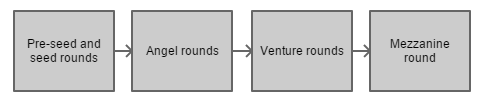
    There are different types of funding rounds. It is not necessary to have the funding in this order, but it does make sense that one would want to try these first, as to maximise your profit.

    • Pre-seed and seed rounds – These are friends and family rounds that are often used to launch an enterprise. One could:
      • Consider a bank loan in this round, as it is not yet exchanging equity for money. The bank will charge you interest and you would need to pay back the money in instalments.
    • Angel Rounds – Angel investors or private investors offer money in exchange for ownership equity, debt (i.e. a loan) or similar. They often offer more than just money, including skills and network support.
    • Venture Rounds – Venture capital firms would invest in your company for equity and promises of returns. The venture rounds are normally named “A round, “B round”, etc. the more rounds of funding needed, the more concerned a venture capitalist (VC) would be as this would infer that the company is probably not sustainable in the long run.
    • Mezzanine Rounds – If a company is planning to do an initial public offering (IPO), i.e. list on the stock market, this type of funding should carry them until the desired outcome is achieved.

    It is worth noting that there are other options for funding as well.

    Banks sometimes approve funding for small businesses. The downfall is that they require securities – a guarantee that the money will be paid back.

    Funds, grants and government agencies – there are multiple grants and help for small businesses. These include the  Small Enterprise Finance Agency (SEFA), National Empowerment Fund (NEF) and the Small Enterprise Development Agency.

    When should I acquire funding?

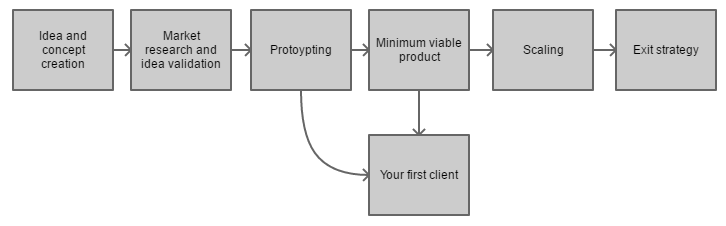
    This graphic is an oversimplification of the process, which will be used a the basis of the process funding analysis.

    It is possible to get funding anywhere in the startup process. For example:

    • Idea phase: Many incubation hubs offer assistance and financial help for founders that have an initial idea.
    • Prototyping and MVP: Many people do not have the financial means to build a prototype or a minimum viable product (MVP).
    • Scaling: Once the business has been established and the business model has been proven to work, the next logical step would be to grow the business. This would cost money!

    Lean principles teach us that we should delay decision making as much as possible – until we have no other choice. This applies to funding as well. A cash injection might help your company a lot, but it might be worth it to first establish a solid foundation: automate processes and do market research and explore the costing model and channels for your product/service.  This makes sense for a few reasons:

    • It is not advisable to give your company equity away if you can avoid it.
    • Your investors become your boss. They want to see a return on their investment!
    • Many companies want early funding for their idea

    Conclusion

    Finding funding for your business can be complicated. Depending on where in the process you are, you might get away with asking friends or family for the cash you need for your business to survive.

    In other cases, you would need to speak to venture capitalists.

    Ideally, you would want to keep all the equity. Bootstrap your company as much as you can.

    And start raising equity when it will benefit you financially.

    Simply be effective.


  • How to find a product/market fit and the four fits framework

    How to find a product/market fit and the four fits framework

    Finding a product/market fit is hard.

    Finding a product/market fit for your product or services is not easy. Sometimes it is like trying to fit a square peg in a round hole. It might sound as simple as connecting your service or product with the right target market. With a new product or service, this might be more complex. For example:

    • You might have the right target market and the wrong product or vice versa
    • A subset of the product might fulfil their needs or a bigger solution might be required.
    • The product might have indirect competition that is upheld by ideological constructs.

    There could be an array of things that could be wrong and discovering what the issue with the fit is could take quite a few iterations.

    Testing for a product/market fit

    Eric Ries famously defined a startup as ” …a human institution designed to deliver a new product or service under conditions of extreme uncertainty…”. As most small businesses of a startup nature don’t know where they fit in, it would make sense to use the build/measure learn cycle.

    We all need to accept the fact that we don’t know what we’re doing. We need concrete proof of what we assume. With any product, we could easily assume hundreds of things, including:

    • People would want to use our product
    • People would be willing to pay x/month for our service
    •  Our product is backed by a blue ocean strategy. 

    Working with our assumptions and getting substantial proof that this is the truth is central to getting that fit.

    Validate your assumptions

    Assumptions can be validated with different indicators:

    • Qualitative 
    • Quantitative 
    • Intuitive 

    The channels of validating your assumptions appear different, depending on your business model, product and channels you want to use.

    As there is not a one size fits all, I would like to use some examples to illustrate how one can validate assumptions:

    • Advertising and idea validation: Testing interest might be as simple as putting up a splash page and running a Facebook ad campaign
    • Existing products/Adding new features: Adding a menu item in your existing product or website to see if your existing userbase wants the new product or service.
    • UX/Usability validation –  Contact sessions with a core group with Copic marker mockups

    By iterating (learning), a better idea can be formed about client expectations and requirements. The art is to do this as quickly and meaningfully as possible, so not to exhaust financial resources.

     The four fits framework

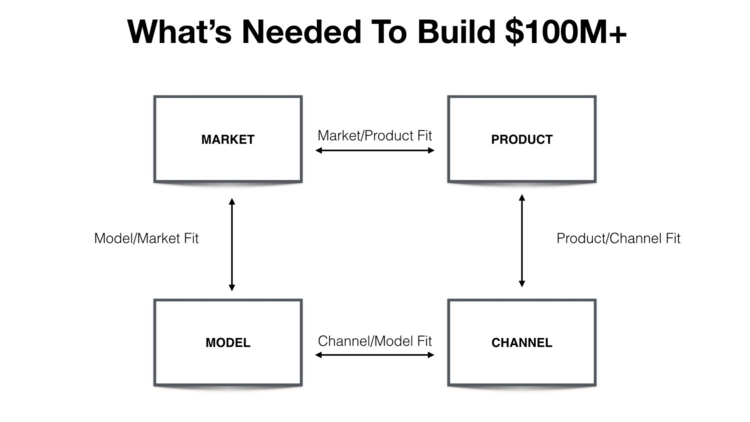
    Brian Balfour wrote about the growth framework. A $100 million company needs to consider four aspects and how they fit together:

    • Product/market fit – does your product fit into the market that you are targeting?
    • Model/Market fit – Your engagement model will show if you need one big customer or several smaller customers (i.e. the market).
    • Channel/Model fit – your engagement model should fit in with your channel. If an advertising model is used, then the ROI model should be sufficient for the channel.
    • Product Channel fit – Whichever channel (Marketing, APIs, Technology) you decide to use, you need to follow the rules. Your product needs to fit into the channel, as you don’t play by your rules, but by theirs.


    Using this framework, one can scrutinise each part of the startup assumptions and validate if this would be feasible and if one would need to explore other indicator options.

    How do I know if the product/market fit has been achieved?

    Achieving Product/market fit means that the product/service does not require additional changes or pivots. The market, model, product and channel have reached a sweet spot.

    There are a few metrics that can assist in deciding that product/market fit has been achieved:

    • The 40% rule – If 40% of the customers indicate that they would be “very disappointed” if they could no longer use the service or as a “must-have”.
    • Online metrics – Most of these metrics can be tracked through Google analytics
      1. Low bounce rate – i.e. the customer expectations are met
      2. Time on site
      3. Pages per visit
      4. Returning visitors – i.e. the impact of your product or service is so big, that they keep on coming back for more.
      5. Customer lifetime value 

    Conclusion

    Understanding the assumptions that are made concerning your product/service will guide you in testing your idea. You need to have proof that you’re on the right track.

    Using the four fits framework, you can establish if you have a good fit in product, market, model and channel.

    Finding a product/market fit is not easy – but worth the journey.

    Simply be effective.

    Sources consulted

  • Do you really need funding?

    Do you really need funding?

    Funding: a quick answer

    Founders and small business owners request funding for many different reasons. In many cases, they have done their due diligence and have proven a product/market fit.

    Many people want to get funding, as this takes the liability off themselves and onto the funder. For others, they would like to scale their company to make more money.

    Though there is not a one size fits all, it is worth exploring all avenues before going the funding route.

    What other options do I have before I get funding?

    The other day I spoke to a lady that asked me for a small loan. She needed R 5 000 to get her business off the ground. I decided to rather take the route of asking questions on how to bootstrap her business. It came out that she wanted to buy stock and wasn’t willing to start small. This was quite alarming for me, as many people want to do a big reveal of a product/service.

    Bootstrapping

    Bootstrapping allows us to learn – what do my customers want? How do they want it? How can I satisfy their needs? We know from success stories such as Netflix and Airbnb that learning is essential to success – and pivoting where needs are.

    A company of one

    Our culture is obsessed with “Bigger is better”. For this reason, Paul Jarvis wrote in his book “Company of One” that we should consider staying small and not scale for the sake of scaling. Explaining that large businesses have more overheads such as an HR department, legal and change management, he noted that his business was able to survive through recessions and bad times.

    While staying small might not be the goal, it should be considered building relationships with customers, automating anything that is eating away at your time and optimising the business process.

    Pre-selling your product or services

    In some cases, you need money to grow. It is an option to test the viability and raise capital by pre-selling your products. There are multiple online platforms that you can sell your products, including Indiegogo, Kickstarter and GoFundMe.

    On the other side, many software people sell products even before they are developed. Giving the customer HTML/CSS mockups, and/or working with the clients to develop the solution might bring cash flow to a business.

    Minimum viable products (MVP)

    For a startup, it is vital to get your first paying customer. With an MVP, you have something to show potential clients and start the learning cycle.

    The biggest issue today with entrepreneurship and code is not building products inefficiently. It is building products nobody wants very efficiently.

    Breaking down requirements can point the founders to what is important to customers. This could cause the MVP to become the product, eliminating the necessity for funding, which would only be required for scaling at a later stage.

    What should happen before seeking funding?

    At some point, a business might require funding. As the goal of a startup is to find a product/market fit and then scale aggressively, it makes sense that funding will be sought as soon as the tipping point is reached.

    In some cases, such as accelerator programmes, the money will be given upfront, with guidance and mentoring.  With most of the startups in South Africa, the scarcity of funding options requires a certain level of innovation and certainty that the offering will deliver on promises of profit, value and expectations.

    The European Innovation Academy identified steps before raising capital. Though these steps are not cast in stone, it is interesting to consider how much needs to happen before getting venture capitalists (VCs) or other funders involved.

    In my experience, startups try to get funding before proper validation (both product/market fit and market research) has been done.

    Though I am not oblivious to the fact that sometimes economies of scale will determine the profitability, it is recommended to keep the business out of the hands of strangers as long as you can, as funders will invest in the perceived value of the company.

    Management and expectations from investors

    Venture capitalists (VCs), Angel investors and other sources of funding will indirectly become your boss when you get funding. According to Jose Cayasso (CEO of Slidebean), investors are looking for exponential growth on their seed investment – not just a 10% or 100% return. 

    The investors will become your boss – and the aim will be to scale the business as quickly as possible so that they can get a return on investment to the investors they represent.

    As the founder, if you need to work fulltime with the startup, there will be no room for a retirement fund or luxuries. Your salary will be absolutely basic necessities. You will need to negotiate hard with your funders to justify why you need the money you need.

    Do you really need funding?

    Though this question is dependent on many factors, a few pointers should be considered before funding is pursued:

    • Has the research been done and shows a market fit?
    • Were all options for pre-selling, MVPs and bootstrapping considered?
    • What type of returns will the potential investors be looking at? Is this sizable compared to the seed investment?

    Conclusion

    Though there is no right answer concerning if you need funding, it is worth noting that we shouldn’t ask for money too fast.

    There is no such thing as a free lunch.

    Consider all the options outside of funding first. Use funding to scale a startup, rather than fund development. Is it possible to fund development through investors? Yes. Yet, it is an expensive test to see if it would work.

    Simply be effective.

  • Will my business idea work?

    Will my business idea work?

    I have a business idea, but I am not sure if it will work

    While having your morning coffee, you think about an innovative solution for an idea – something you can convert into a multi-million rand company. Or maybe, you have the supplier ready and awaiting your order, but not sure if your business idea will work.

    Many businesses will encourage you to do business plans, non-disclosure agreements and other business-like things, but the idea first needs to be formulated well and validated as something worth investing your time and money in.

    All that glisters is not gold

    -William Shakespeare

    What questions need answers?

    At the heart of any small business or startup is the validation of the following questions:

    • Do people want what I offer?
    • Are they willing to pay money for what I offer?
    • How much money would I need to spend on getting something out – and can I afford it?

    With this in mind, let us start looking into the validation of the idea.

    The business idea validation process overview

    When looking at viability, it is important to not waste any time that could be spent more effectively elsewhere. By starting with a quick Google search, one might be able to make a decision on the viability of the idea within minutes, rather than days or weeks.

    Competitors of my business idea

    Before pouring heart and soul into an idea, one needs to first understand the playing field. What competition is currently existing in the market?

    Foundr recommends asking the following three questions:

    1. Is there competition in my space?
    2. Are my competitors making money?
    3. How can I implement my idea differently and better than my competitors?

    To do this, we need to consider direct and indirect competition – direct competition means products/services that are similar to your offering, whereas indirect competition refers to other means that your needs can be fulfilled.

    Many startups and small businesses driving disruptive innovation will have difficulty validating their idea with competition analysis, as it isn’t always direct competition – and this could be okay.

      In Practice

      In practical terms, it is worth checking out the following in your research:

      • Do about 10 Google searches for similar products
      • Check out Google Trends, App Store, Play Store and other platforms where you’re planning to launch your idea from.
      • Speak to people that use the competition’s products
      • Speak to friends, family and business acquaintances about your idea

      Converting my business idea into a money machine

      An idea is great, but the question of profitability will mean the difference between success and failure.

      A company like Facebook realised early on that they will have the eyeballs. It was only a matter of time before they were able to monetise the product and cash in. It is however good to start thinking about how the idea will generate money and cash flow.

      Engagement models are the way that money will be generated and what needs to be done to make that money. The basic models are cost plus, fixed cost, cost for time and retainers.

      To give practical examples of how this could be applied, here are some examples:

      •  Software as a service (SAAS) – a fee can be charged as a monthly subscription fee to use the service.
      • Membership sites – content could be provided at a recurring cost
      • Selling products (digital or physical) through emails, websites or at a market
      • Add a finders fee or markup on sales and outsourcing of products (e.g. affiliate marketing or project management of developers)

      Verifying your marketing and channel

      Consider where your potential customer will be found. How will you reach them and what would the cost be per acquisition? At this stage, it would make sense to do a guestimate – just to get a rough idea!

      The channel you would have to use to sell your product or services will have some limitations. For example, if you have a mobile app, you are required to have all payments go through the store. The store adds a markup to all sales and thus needs to be considered when doing a costing.

      What if there is no competition for my business idea?

      It is not wise to spend 6 months and a few million rand to see if an idea can work.

      Eric Ries used the example in The Startup Way when he consulted with General Electric on a new generator. The cost of getting the generator to market was substantial, with about 2-3 years of development time to get the production line set up. He was able to lean this to less than three months to have a working prototype in a client’s hands by spending a fraction of the cost.

      Prototypes could be made out of cardboard, paper, in photoshop or in 3D software. You can even do an HTML mockup to show what the software will do!

      Do it as lean as possible. For more information on lean and wastage, I wrote another article here.

      Conclusion

      Don’t spend thousands or millions on something if you don’t have empirical evidence that it will work. Spend as little money as possible to validate your ideas – and scale accordingly. Ideally, you want to get your product (that customers actually want) to market as fast as possible (more info on this here).

      When looking at if your business idea will work, you need to consider the competition of your product or service.

      You also need to look at cash flow and the potential for making money – how much will the business make?

      Do good research and do it quickly.

      Simply be effective.

      Sources consulted

    • I need business ideas – where do I find them?

      I need business ideas – where do I find them?

      Where do you find great business ideas?

      I did a Tweet the other day about small business and ideas. We often complicate the generation of business ideas unnecessary, as we believe innovation and solutions are out there… and we are here. 

      For this reason, I decided to explore idea creation and problem solving processes in this post. I believe the principles are universal – for startups, small businesses and side hustles.

      Let's talk about discovering side hustle ideas – a #THREAD.
      Ideas are a dime a dozen, but like writer's block, it can be daunting needing to think about something to do.
      We'll talk about monetization and viability in another thread 😉

      — Frugal Local 🇿🇦 (@FrugalLocal) January 3, 2021

      Positioning yourself for great business ideas

      Make sure you positioning yourself for greatness. 

      Consider the people you hang out with. Stay clear of people that shoot down your ideas, break your spirit and leave you dazed and confused. Surround yourself with the type of people that you want to become.

      It is also highly recommended to keep an ideas journal. This could consist of drawings, graphs, charts, bullet points or just notes. Creative ideas take shape in strange places, including in the shower, in a business meeting or while researching a tough coding problem. 

      What evokes emotion?

      We all have things we enjoy – this might range from drinking coffee, coding to making magwinya (vetkoek). We also have things that make us want to jump off cliffs – these could include shopping, bad service, negativity or terrible food.

      Emotion is a powerful driver in finding ideas that can be monetised into a side hustle, small business or even into a tech startup. I see it as a nail sticking out of a table that scratches everytime you touch it.

      Matching your business idea to your passions and talents

      It doesn’t help if your idea doesn’t match your passions and talents. Write down all your passions and talents – what do you enjoy doing, what are you good at?

      When your idea is converted into a money-making business, you would be required to spend countless hours on it.  It thus makes sense that you align these with who you are.

      Consider the following channels of discovery:

      • If you have not done so, I recommend doing personality tests (such as 16 personalities).
      • Draw up a grid of skills, talents, passions and interests. 
      • Connect with lines where these overlap.

      Networking and business ideas

      The power of your business is directly linked to your success. Remember – making money is about people. It’s about adding value to them. 

      Don’t underestimate the power of surrounding yourself with people that are more knowledgable than yourself. They will bring wisdom and insights into your idea. Do not be afraid to share your idea. 

      Eric Ries said in the Lean Startup that the fear of sharing an idea is unfounded – “If your idea can be stolen that quickly, it is not a great idea”.

      Take the time to build your network and position yourself around the right people. Consider the playing field – your industry, clients and potential business customers. These should give you an idea about where you need to be steering your online presence and friendships.

      Mastermind and innovation groups

      It is worth looking into joining a group dedicated to innovation and change. These people tend to become friends, as they are kept accountable to each other. 

      Having brainstorming sessions with a few friends might also be worth it!

      Leveraging your resources for success

      Resources is not only money, it includes time and education. 

      Though I fully believe that anyone can start a business with very little money, some businesses require more resources. Understand what resources you require and what you need to have to make this work. 

      In some cases, you might have the technology available at your disposal but need the application. Discover what you need and fill that need. 

      Discovering what customers want

      Many founders do not have an idea of what customers want. This is normal. Even more people don’t have an idea yet – and that is okay. 

      When you have trouble coming up with a valid idea, we should consider positioning ourselves closer to potential problems. Seeing what customers do will assist us in finding a solution to a problem that we have not yet identified. 

      Horst Rittle explained about wicked problems – these are problems that can only be solved, time estimated and understood by doing. Do not be afraid to start doing – just keep track of how much time and effort you are putting into it. 

      Keep track at what point it becomes unviable to pursue something.

      Conclusion

      Coming up with an idea is challenging. Getting started by writing down what evokes emotion as well as what skills, abilities and talents are available to you. 

      Having a co-founder does help, but it is recommended leveraging your network, but is not essential to success. 

      Do not let an idea just sit there. You need to grow it. It is recommended to validate your idea through the build-measure-learn cycle – you don’t want to build something no one wants!

      Simply be effective.

    • Maximising software development productivity

      Maximising software development productivity

      Make productivity a priority in software development

      We’ve all had those projects with tight deadlines that had to be met. Once all the code was completed, checked and ready for deployment, the product owner decided to postpone deployment. In many cases, projects were completely shut down even before deploying to live! Maximising productivity is a vital task that should be the focus of any organisation.

      Whether you’re coding, doing online marketing or offering a product/service – it is important that everything is done to enhance productivity. 

      A lot could be said about having the latest technology, automation and systems in place to make changes simple and easy to navigate around. On the other hand, working on the right things will have the right outcome. 

      Unnecessary Features

      We would like to give our customers the best. We all want to make sure that they get value for money. Sadly, most of us don’t know what the customers really want. 

      One of my clients told me the story where they were told that they had to build a R 1.3 million feature, or they would not be able to use their software. They built the feature. They decided to track the feature usage and discovered that after it was created, it is never used. 

      Waiting (for requirements, testing, etc.)

      When using methodologies such as waterfall, there could be times when the developers have nothing to do. They sit waiting for features to be approved. In other cases, when testing ideas or waiting for customer feedback, it could eat away at our productivity time. 

      Ideally, a just in time production system makes sense to optimise the time spent. 

      Over-engineering

      All processes are optimised for something. These optimisations include stability, performance, extendability and configurability. Each of these has issues that could cost valuable time: 

      • Stability – unnecessary infrastructure
      • Performance – premature optimisation
      • Extendability and configurability – added complexity without a definite plan/requirement that the code will be used

      In the context of other solutions such as e-commerce, one could easily want to overcomplicate the solution – Shopify might be an excellent solution for a basic e-commerce solution. It would not make sense to add extra complexity such as conditional shipping options and multi-currency support.   

      Keep your solution as simple as possible.

      Scoping and sizing

      Some projects never get off the ground. Yet, one can easily spend years in a state of analysis paralysis. If you work in an agile environment, the sizing should never be more than one sprint ahead of the development sprint.   

      Automation and using underutilised tools

      In many cases, one doesn’t need complex consultations and processes to achieve what you need. Many tools exist such as Zapier that can help you automate your business. You could also optimise your deployment cycles with CI/CD software.

      Quality code

      Code quality should never be sacrificed to deploy a feature or bug fix. It is vital that processes are in place for unit tests. code reviews and pull requests. These are a safety net in case something goes awry.

      Underutilised skills in the team

      Every team member brings unique skills to the table. Once the skills matrix is mapped to the team members, one can decide how to optimally use the skills available.  

      Uncompleted work

      Sometimes, during an incident, all hands need to be on deck. Other times an urgent request requires all work to be stopped and focus be diverted to the new feature. When other features are not finished, it is often left on a new branch – where it is left to die.

      Work that is started needs to be completed.

      Conclusion

      Productivity needs to be made a priority. The focus of a company should be to finish the features that were started. 

      Make sure that the feature is necessary, concise and completed. 

      Use all the tools available to the team to achieve the outcome.

      Simply be effective.

    • Deliver quality solutions by focusing on learning

      Deliver quality solutions by focusing on learning

      Developers and users

      Software developers have historically been portrayed as mushrooms sitting in a darkened room. It is forbidden for them to connect with the business units. It also makes sense, as focus is needed to produce quality code.

      It is also unthinkable for a developer to contact a client directly to understand how they use the software.

      Let us shift our perspective away from the traditional silos for a while and look at the impact it would have to move developers to the forefront of the software development lifecycle (SDLC) – the gathering of requirements.

      Unused and unfit code

      Every company has a few solutions that never made it to production. Money was wasted on something that was believed to add value – but didn’t.

      Imagine the opportunity to find which part in a solution does not add value. How would the landscape change if we could stop a process that doesn’t add value before it even starts? By closing the gap between the end-user and the developer, this would be identified well in advance.

      Mary Poppendieck describes the difference between development and production. She likens development to the creation of a recipe, and production to following the recipe, with the principle differences outlined in the table below:

      Development Production
      Quality is fitness for use Quality is conformance to requirements
      Variable results are good Variable results are bad
      Iteration generates value Iteration generates waste

      Iterations

      The focus should be on learning what adds value and what is a waste. To avoid relearning, the team can keep track of all the functions in an excel file, with supporting documents in a folder in the cloud or on a shared drive.

      This should be accessible to everyone in the team.

      On a practical level, it would look something like this:

      • A feature has been requested
      • What would be the most valuable assumption that could be tested? What can we learn from this?
      • How do we code to test our assumption?
      • Can we build just the user interface without any features and check with users if the idea works?
      • Once implemented, how can we measure what we’ve learned?
      • How does what we’ve learned change our view and way forward?

      Let’s look at an example.

      A request came through for doing credit checks on multiple people at the same time to check for the affordability of a loan. It included complex email business logic depending on what your partner’s credit score is.

      In a traditional business, this would go to the business analysts that would break this down into stories to build. Within a business focused on learning, the team would question how could we test if this would add value:

      • Can we add a menu item on our website and a contact form to test if this would work? Can we track this through Google Analytics?
      • Should we include the complex emails, or can we just to the multiple credit checks for now?
      • What part of the feature will add the most value?
      • Is this feature at all necessary? How can we prove that we should build this feature at all?

      Destroying silos

      Unless the business consists of a single person, it would be best to let the team decide on how to test that the idea will be viable.

      Developers understand code.

      Business understands the requirements.

      The client uses the software every day.

      Though software developers tend to dislike meetings, it would be worth it if they assist in defining what needs to be learned and how to measure the outcome. By closing the feedback loop between the coder and the user, the learning can be accelerated. Here are some ways to do this:

      • The business analyst should have regular conversations with the coder and user to establish what would be quick wins, what is doable and what will take more effort.
      • Get developers to shadow users in a focus group
      • Have regular sessions with business, business analysts developers and users so that everyone is aligned on where the software is heading
      • Allow developers to speak to users directly when resolving bugs and issues

      Conclusion

      A business should work as a team. Work together to learn and grow.

      Avoid silos – learn as a team what will work and what will not.

      Keep track of all learning so that one could refer to it at a later stage.

      Simply be effective.


    • What is a diagnostics phase and why do we need it?

      What is a diagnostics phase and why do we need it?

      The issue with a quick quote

      When new clients meet me for the first time, they often talk about the idea that they have for a new web or mobile app, their goals, aspirations and product positioning. With product development, client expectations can be matched by a simple grid of what the product can and cannot do.

      Bespoke software development on the other hand is a bit more challenging. The client has a certain picture in his head about what he requires. Yet, requirements are never set in stone.

      As clients see their product being built, changes often creep in. In the same way, as users use the software, the client’s needs evolve.

      To avoid a mismatch of what the client wants and what the developer (or tech partner) develops, it is best to pin down exactly what is required. This is generally done in a business requirement specification (BRS).

      Once a blueprint of requirements is pinned down, a proper estimate of time and cost can be given. Tasks can also broken down into small chunks and delivered in an agile/incremental fashion.

      Understanding the requirements

      From a business perspective, it does make sense to understand what is required. However, it seldom offers insights into the end-user of the software.

      The users are often neglected for the greater vision and mission of the company, seen as a lagging factor that ‘users will get used to’. For a better view of the business and its requirements, it makes sense to include the following in the diagnostics phase:

      • Business requirements
        • Business goals for the solution
        • Timelines and output requirements
      • Expectations of the user
        • User personas – who will be using the website/software/app
        • Story flows – what would each of the users like to do and how will they achieve this
      • Technical requirements
        • API integrations
        • Third-party dependencies
        • Technology, architectural and code considerations

      The BRS – Needs mismatch

      Many clients would explain to me that they already have a BRS with a full needs analysis. It makes total sense that they would not want to pay again for another needs analysis. It would also be irresponsible of the new technology company to start solving client problems before they are engaged.

      Effectify focuses on simplifying what the clients think they need. For example, we know that a client has a 250 page BRS, a pitch deck and 10-year marketing plan for their innovative mobile app.

      With these details, we need to consider breaking down the project in smaller chunks – maybe there are online solutions, open-source code, APIs and third-party products that could decrease the time to market.

      Although the client would want to have a bespoke software solution, the need on a project could possibly be satisfied by other means that are more cost-effective, time saving and still deliver the same value.

      Conclusion

      It’s vital that the technology partner can do the job, but it is also important that you get along with them.

      The diagnostics phase is as much about requirements and understanding the business as getting to know your customer.

      Simply be effective.

    • Should I pivot, persist or quit my startup?

      Should I pivot, persist or quit my startup?

      Choosing the right response to the problem

      Every business reaches the point where what they are doing is not working anymore. Small businesses and startups can reach this point much faster than bigger businesses with more diversified product offerings.

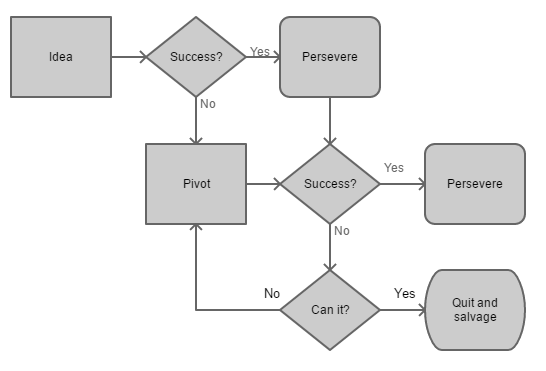
      When any business reaches the point where they realise that what they have is not working anymore, we need to make a decision: persist, pivot or quit?

      Before we get started, let us clarify what is meant with these bug terms:

      • Persist – when your idea/business/offering is sort of working: you have some clients, but it needs a bit refinement to make the product fit
      • Pivot – you have done the refinement, but you stil cannot get a good market fit. The feedback you’ve received back from your users/potential customers doesn’t fit into your initial hypothesis and problem to be solved. You would need to radically change your problem statement, target market etc. to reapply the solution (or part of it) to someone else
      • Quit – when you don’t see any way of salvaging the solution of pivoting. Don’t just quit!

      Explore/Exploit

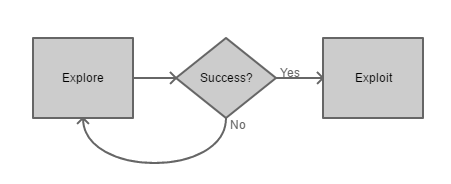
      In computer science, the explore/exploit algorithm teaches us the following: When something is worth it, keep on exploiting it until proven that it is not worth it anymore. When this point is reached, one should start exploring again.

      This exploring could mean three things.

      You could tweak your product offering to make it better. This is what Clayton Christensen refers to as sustaining innovation – the process of refining, tweaking and sustaining what you have. This is also the best way to optimise profit and add customer value to the existing product or service.

      If you decide to pivot, you realise that your hypothesis that you made initially was found to be untrue. In this case, you need to start with another assumption and hypothesis and retry the business in a new sphere. This could be a new target market, new (or sub) feature set, new approach or new angle.

      Lastly, you might decide to quit and salvage what you have. I refer to this as canning the project/business/startup. In this case, one might need to consider the following:

      • You have pivoted to a more successful business model, but none of these have worked. The startup is a bottomless pit eating all your money and it’s just not sustainable
      • The team dynamics is just not working – your startup team is causing division in the vision and process.
      • Other opportunities arise that are more lucrative and more sustainable

      Value innovation

      When deciding on preserving and/or pivoting, one needs to consider moving closer towards adding value to customers, while bringing down costs, effort and/or time required.

      As most startups are what Chan Kim and Renée Mauborgne calls a “blue ocean” (an uncontested market with a new innovative approach), it makes sense that these businesses should move toward adding maximum value to customers without the perception of paying more than they believe they should for the convenience

      Product Market Fit

      We know that the purpose of any startup is reaching product market fit. This means that customers want the product and are willing to pay for it. The reason that one would pivot or tweak, is to make it fit in with the feedback from the build-measure-learn cycle.

      If the offering does not fit the feedback, either tweaking or a pivot is required to make it fit. Choosing which of the two to implement depends on the degree that the initial hypothesis has been disproved.

      The pivot

      There could be a plethora of reasons that justify a pivot. In some scenarios, it might not mean that you need to rewrite the whole solution. Other pivoting options include:

      • Change the target market of your product
      • Change your business model
      • Revamp your engagement/revenue model
      • Take a subset of your existing product or service and spin it off into its own product or service

      Some of the reasons you need to consider when pivoting include:

      • Red oceans – too much competition
      • The company is not growing
      • a subset of your services/product offering is getting more traction than the actual service
      • You have changed: when the founder’s perception, knowledge (and revelation) of the market changes, it needs to reflect in the business/startup.

      Conclusion

      Choosing whether to pivot, explore or can a project or business is never easy. We are often emotionally involved and have difficulty making rational decisions.

      When considering whether to explore or pivot, one needs to consider all options including whereto, what will be at stake and how one will achieve the desired outcome.

      Don’t pivot because you can, but rather because you know the product market fit is just not there.

      Only quit when you have all the facts on the table and it’s absolutely not worth it anymore.

      Simply be effective.

      Sources consulted