Category: Planning and research

  • How I saved a client millions with a one liner

    How I saved a client millions with a one liner

    A client requested business consulting and solutions architecture services from me. We decided to have our first meeting in a casual setting – a coffeeshop in Pretoria. It was situated close to his target market, so that we could immerse ourselves in the environment.

    We started off by chatting about the pain points he is trying to solve – statistics, analysis and buy-in from a big organisation that he would be targeting. The project was funded by the founders, and therefore bootstrapped.

    Development was already on the way.

    The dev team was doing an exceptional job. The latest cloud technology was used with great front end libraries to build out features. The minimum viable product was coming together.

    The client was well connected with a big organisation. This would be their gateway to reaching their target market.

    But something was missing.

    What’s missing from your MVP?

    This simple question drained all the colour from my client’s face. They have been working hard for more than six months, and have never had this in front of the end consumer – the person that would actually use the app.

    This is more common than you might think.

    The single question – another case

    A few years ago, I was working at a large investment firm. We were developing a complex new retirement product that was described as ‘revolutionary’ and ‘innovative’. The issue was that the team worked for more than six months to push out this new product.

    I often wonder how much of their existing retirement business was cannibalised by this new product – and how this would be measured in such a big company.

    I’m not against extending your product range or horizontal integration. But it should be done with due diligence and small, measureable steps. Especially if your startup doesn’t have large capital to spend.

    What did I do for the client?

    Getting the product in front of an end user was critical. And maybe we didn’t even need code for it right now. I opted to design the user interfaces on Figma, and link the pages with buttons so my client could show this to end consumers.

    What do we learn from this?

    Feedback received from users will shape the business.

    It’s such a simple thing. Such a simple question. But when we’re heavily invested in our own business, we forget to ask the obvious questions.

    How can I help you?

    Yes I can code. But also I ask critical questions to save my clients money and empower them to make better business decisions and refine their offerings.

    If you’re looking for a turn key software developer, feel free to schedule a free first consultation.

  • Executing your small business strategy

    Executing your small business strategy

    Reaching your goals by execution

    Susan created a startup to do document management for medium sized businesses. Having a mission, vision and execution strategy in place, she believes she is on the right track to get a product market fit – but has a problem executing the strategy that she has pinned down.

    This situation is not unique. 70 % of strategic transformations fail – and the rate of startups and small businesses failing is close behind this number. As a matter of survival, we need to measure the health of our business and then determine if we are on track to reach our goals.

    The different strategies for different businesses

    I find that there are three different types of company structures: organisations with high levels of uncertainty, businesses with a formula and big corporates. Each of these have different aims, goals and execution paths.

    Organisations with high levels of uncertainty – those doing groundbreaking work and have no existing frameworks to lead from, would require a lean build-measure-learn approach. For example, in the above startup, Susan might need to pivot at some stage. This might happen when her customers expect a different strategic alignment of her offering to their vision.

    Many small businesses have a formula that they can use to achieve their vision. This includes the insurance tech – Ubelele wrote an excellent article here on how you can use a formula to launch an insurance app (Naked, Simply, JaSure).

    You also have a corporate strategy. There are generally three strategies that are focused on:

    • Growth strategy – when a big business is looking to expand its services, products and offering
    • Stability strategy – when an organization keeps the status quo and adds more stability to its existing infrastructure.
    • Renewal strategy – if there is a decline in the performance of an organization. This would either mean retrenchment or a turnaround strategy.

    Breaking down the execution

    If you are working in an environment with a high level of uncertainty, you need to break it down into bite sized chunks. This can be broken down as many times as needed. Being overwhelmed, you need to decide on an area of focus.

    In the book “The 4 disciplines of execution”, the authors refer to a concept called WIGs – wildly important goals. WIGs are small, dial lifting changes that can be implemented to move your company forward. If you can reach this small goal, then it would have a huge impact on your business, revenue, inter alia freeing up time.

    These can be decided weekly or bi-weekly.

    Focus on small wins

    In some cases, the WIGs can sometimes be big wins – and can take two weeks to execute. Make effort to break it down into smaller daily wins. Remember – you need to motivate yourself (and your staff) to grow your business in the right direction.

    And small daily wins can serve as a great motivation

    Aligning staff members

    Though this section deserves an article by itself, I want to touch on staff and your strategy.

    Many businesses do not engage staff meaningfully. Staff members need to do the grunt work, without the a clear buy-in of the vision. Make it a priority to communicate your vision and strategy on how to get there with your staff members.

    They need to feel valued and part of the plan.

    Make sure expectations are communicated, measured and broken down accordingly.

    Align KPIs and performance to the goal – this is why you have KPIs and performance reviews in the first place.

    The power to say no

    As a small business owner, I find that there are many opportunities that come my way – anything from fun little projects, startups looking for a technology parter to large projects where you need a team of hundreds of developers.

    To align my company with the vision and strategy, I have learnt the power to say no.

    When you say no to something, you say yes to something else.

    It is not wrong to say no to a project that is easy money – you need to make tough decisions to align yourself to who you want to become. If it does not fit into your vision or strategy, then say no.

    Measure & evaluate

    No company can move forward without vision.

    Without implementation of a strategic roadmap, you will never get where you want to be. But how do you know your actions have the desired effect? Are you moving in the right direction?

    For this there needs to be a measurable outcome to your goals, mini goals and tasks. The smaller the measurement, the quicker you will be able to get back on track if you have strayed away from the main goals. These measurements can take many forms. Here are some examples:

    • Do weekly evaluations if the customers you have and attract are in alignment with your company vision
    • For software development projects – checking if the velocity and tickets align with the end goal (e.g. delivery date of a specific feature)
    •  Financial alignment with features and services added – Use dashboards to see the impact of your changes

    Conclusion

    In some cases, a formula can be followed for growth. For startups and businesses in an environment of high uncertainty, it might not be as simple as to have a clear long term goal other than client take up and financial stability.

    The key concept in reaching your goals in business is execution – we need to action our plans to achieve.

    If your goals are too big, then add mini goals. Add tasks. Add sprints.

    Be efficient in measuring your outcome. You need to know within two weeks if you are not on target to achieve your goals.

    Enjoy your business.

  • When should I rewrite an existing system?

    When should I rewrite an existing system?

    Before you rewrite an existing system

    To rewrite an existing system takes time, money and effort. The decision should not be taken lightly. A large number of resources (money, man-hours, management) will be poured into the new solution. A fair amount of analysis will also need to be done upfront, with estimates of new hardware requirements, technology costs and the training learning curve that will eat into your developer’s time.

    When considering a rewrite, you need to think about your existing codebase  (quality, versions and architecture), the software you use (e.g. hosting operating system, database management too) and the obvious time/money/quality equilibrium.

    What is legacy code/software?

    Defining legacy code/software can be challenging. Here are some of my favourite definitions:

    • The code I checked into source control this morning
    • Software that is no longer supported by the company that published it (e.g. Windows XP)
    • Software or code that has a very limited number of developers in the world that specialise in it and is older than 5 years.

    It really boils down to this: is your legacy software holding you back from scaling your business? do you want to grow your business, but don’t have the ability due to constraints?

    The maintenance/green fields dilemma

    Most developers want to work on new systems. They want new technologies, new challenges and to create something fresh and challenging. Whoever the person is that will need to maintain the solution – well, that is irrelevant. In my experience, I see and hear many developers who leave a company as soon as they are forced into a support role.

    Having said that it is challenging for a business to start a project from scratch again. The reason as all the business rules are hardly ever documented. Spending a year in an attempt to get business analysts to assess the solution is also not necessarily viable – especially for small and medium-sized businesses.

    As with all things, in business there is a trade-off between quality, time and money. It is often believed that staying with the status quo will be more cost-effective.

    The real cost of legacy systems

    When I was still working as a fulltime developer, I sat in a meeting where I explained to my (then) boss that the code was a mess and it was just impossible to manage. We also didn’t have unit tests, continuous integration or any means to note if something broke. His response was simple: “Well, it is working”.

    I find that software developers cannot always tell the business what is really happening under the hood in the code. Here are some factors to consider and discuss before doing a rewrite – and some to discuss with your tech partner:

    • Developer turnover – what is the cost of training new developers on a legacy system? What if your current developers leave?
    • Legal implications – what would happen if changes need to be applied or the system fails due to spaghetti code?
      • For example, if your code base generates legal documents in different locations. A legal change has to be implemented, but your developers cannot guarantee that all the changes will be implemented in all the locations.
    • Financial impact – With the amount of support, inflexibility and constraints, is the legacy software stopping you from expanding your business?

    Legacy code has a much bigger impact on a business than we would like to believe.

    Complexity and the rewrite

    Many business systems are very complex – some with good reason (such as complex financial systems). Other systems tend to be boiler-plated and made more complicated to future proof the system (e.g. dynamic configurability).

    When rewriting a system, it makes sense that one would want to have the code as open and as extendible as possible – yet one needs to consider the maintenance, learning curve of new developers and the resources that are wasted by not getting to market quickly enough.

    I don’t want to rewrite my existing system

    Any system will at one time or another become legacy. Your system will need an upgrade at some time in the life of the business. It is also fair that there might not be an opportunity today for the rewrite.

    Let us take the following scenario. An MVC (C# .NET) solution was written about 10 years ago. The version of MVC is outdated, it is running on SQL 2000 and contains more than 10 years of business logic and fine-tuning. As a stable system, it makes sense that you don’t want to tinker too much with it.

    There are however certain elements that one can change to upgrade the solution incrementally:

    • Set a day every week that will be spent on upgrades.
    • Consider upgrading the testing servers/database first. The testers will be able to find issues fast here
    • Upgrade the packages and linked libraries to the latest versions.
    • Have a rule that unit/integration tests be added whenever a bug is fixed.
    • Consider extracting the code logic – This could be done in a separate project,  into DLL libraries or an external solution in some cases. This will make it easier to rebuild the solution when the time comes.

    Keeping software clean and well maintained can assist when the time for a rewrite comes. It also gives the team a sense of pride and accomplishment.

    I need a rewrite

    When the risk becomes too big, it makes sense to rewrite a legacy system. In this case, it would be prudent to:

    • Find a minimum viable product that would cover at least a small business case. Start with this small dial lifting change and then grow your business. Get something out to the client or business as soon as possible.
    • After the MVP, focus on the next small feature that will have the biggest impact on the business
    • Make sure that the software is well documented – this might not be important right now, but will be exceptionally important later on.
    • If the old and new systems can be run in parallel, then do so until the new system fulfils all the requirements.

    Conclusion

    Not all legacy code needs to be rewritten – and not all systems should be upgraded to the latest versions. We need to understand that there is a risk to keep old code and software as-is in our businesses.

    Make sure that the risk will not drive away developers or leave the business cripple once the system falls over due to a vulnerability, exploitation or hack.

    When deciding on rewriting your legacy system, start with something small – focus on dial lifting changes that will make a big difference in the company. These should be small chunks/sprints, so that direction can be changed quickly without costing too much.

    Keep your pulse on the technology, cost and maintenance.

    Enjoy your business.

  • How to find a product/market fit and the four fits framework

    How to find a product/market fit and the four fits framework

    Finding a product/market fit is hard.

    Finding a product/market fit for your product or services is not easy. Sometimes it is like trying to fit a square peg in a round hole. It might sound as simple as connecting your service or product with the right target market. With a new product or service, this might be more complex. For example:

    • You might have the right target market and the wrong product or vice versa
    • A subset of the product might fulfil their needs or a bigger solution might be required.
    • The product might have indirect competition that is upheld by ideological constructs.

    There could be an array of things that could be wrong and discovering what the issue with the fit is could take quite a few iterations.

    Testing for a product/market fit

    Eric Ries famously defined a startup as ” …a human institution designed to deliver a new product or service under conditions of extreme uncertainty…”. As most small businesses of a startup nature don’t know where they fit in, it would make sense to use the build/measure learn cycle.

    We all need to accept the fact that we don’t know what we’re doing. We need concrete proof of what we assume. With any product, we could easily assume hundreds of things, including:

    • People would want to use our product
    • People would be willing to pay x/month for our service
    •  Our product is backed by a blue ocean strategy. 

    Working with our assumptions and getting substantial proof that this is the truth is central to getting that fit.

    Validate your assumptions

    Assumptions can be validated with different indicators:

    • Qualitative 
    • Quantitative 
    • Intuitive 

    The channels of validating your assumptions appear different, depending on your business model, product and channels you want to use.

    As there is not a one size fits all, I would like to use some examples to illustrate how one can validate assumptions:

    • Advertising and idea validation: Testing interest might be as simple as putting up a splash page and running a Facebook ad campaign
    • Existing products/Adding new features: Adding a menu item in your existing product or website to see if your existing userbase wants the new product or service.
    • UX/Usability validation –  Contact sessions with a core group with Copic marker mockups

    By iterating (learning), a better idea can be formed about client expectations and requirements. The art is to do this as quickly and meaningfully as possible, so not to exhaust financial resources.

     The four fits framework

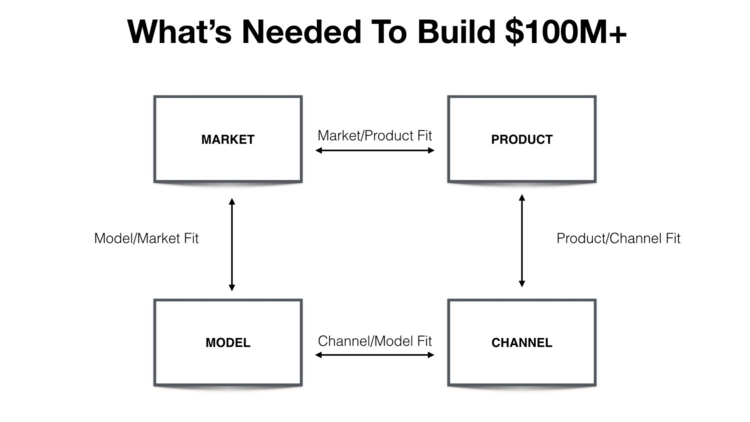
    Brian Balfour wrote about the growth framework. A $100 million company needs to consider four aspects and how they fit together:

    • Product/market fit – does your product fit into the market that you are targeting?
    • Model/Market fit – Your engagement model will show if you need one big customer or several smaller customers (i.e. the market).
    • Channel/Model fit – your engagement model should fit in with your channel. If an advertising model is used, then the ROI model should be sufficient for the channel.
    • Product Channel fit – Whichever channel (Marketing, APIs, Technology) you decide to use, you need to follow the rules. Your product needs to fit into the channel, as you don’t play by your rules, but by theirs.


    Using this framework, one can scrutinise each part of the startup assumptions and validate if this would be feasible and if one would need to explore other indicator options.

    How do I know if the product/market fit has been achieved?

    Achieving Product/market fit means that the product/service does not require additional changes or pivots. The market, model, product and channel have reached a sweet spot.

    There are a few metrics that can assist in deciding that product/market fit has been achieved:

    • The 40% rule – If 40% of the customers indicate that they would be “very disappointed” if they could no longer use the service or as a “must-have”.
    • Online metrics – Most of these metrics can be tracked through Google analytics
      1. Low bounce rate – i.e. the customer expectations are met
      2. Time on site
      3. Pages per visit
      4. Returning visitors – i.e. the impact of your product or service is so big, that they keep on coming back for more.
      5. Customer lifetime value 

    Conclusion

    Understanding the assumptions that are made concerning your product/service will guide you in testing your idea. You need to have proof that you’re on the right track.

    Using the four fits framework, you can establish if you have a good fit in product, market, model and channel.

    Finding a product/market fit is not easy – but worth the journey.

    Simply be effective.

    Sources consulted

  • Do you really need funding?

    Do you really need funding?

    Funding: a quick answer

    Founders and small business owners request funding for many different reasons. In many cases, they have done their due diligence and have proven a product/market fit.

    Many people want to get funding, as this takes the liability off themselves and onto the funder. For others, they would like to scale their company to make more money.

    Though there is not a one size fits all, it is worth exploring all avenues before going the funding route.

    What other options do I have before I get funding?

    The other day I spoke to a lady that asked me for a small loan. She needed R 5 000 to get her business off the ground. I decided to rather take the route of asking questions on how to bootstrap her business. It came out that she wanted to buy stock and wasn’t willing to start small. This was quite alarming for me, as many people want to do a big reveal of a product/service.

    Bootstrapping

    Bootstrapping allows us to learn – what do my customers want? How do they want it? How can I satisfy their needs? We know from success stories such as Netflix and Airbnb that learning is essential to success – and pivoting where needs are.

    A company of one

    Our culture is obsessed with “Bigger is better”. For this reason, Paul Jarvis wrote in his book “Company of One” that we should consider staying small and not scale for the sake of scaling. Explaining that large businesses have more overheads such as an HR department, legal and change management, he noted that his business was able to survive through recessions and bad times.

    While staying small might not be the goal, it should be considered building relationships with customers, automating anything that is eating away at your time and optimising the business process.

    Pre-selling your product or services

    In some cases, you need money to grow. It is an option to test the viability and raise capital by pre-selling your products. There are multiple online platforms that you can sell your products, including Indiegogo, Kickstarter and GoFundMe.

    On the other side, many software people sell products even before they are developed. Giving the customer HTML/CSS mockups, and/or working with the clients to develop the solution might bring cash flow to a business.

    Minimum viable products (MVP)

    For a startup, it is vital to get your first paying customer. With an MVP, you have something to show potential clients and start the learning cycle.

    The biggest issue today with entrepreneurship and code is not building products inefficiently. It is building products nobody wants very efficiently.

    Breaking down requirements can point the founders to what is important to customers. This could cause the MVP to become the product, eliminating the necessity for funding, which would only be required for scaling at a later stage.

    What should happen before seeking funding?

    At some point, a business might require funding. As the goal of a startup is to find a product/market fit and then scale aggressively, it makes sense that funding will be sought as soon as the tipping point is reached.

    In some cases, such as accelerator programmes, the money will be given upfront, with guidance and mentoring.  With most of the startups in South Africa, the scarcity of funding options requires a certain level of innovation and certainty that the offering will deliver on promises of profit, value and expectations.

    The European Innovation Academy identified steps before raising capital. Though these steps are not cast in stone, it is interesting to consider how much needs to happen before getting venture capitalists (VCs) or other funders involved.

    In my experience, startups try to get funding before proper validation (both product/market fit and market research) has been done.

    Though I am not oblivious to the fact that sometimes economies of scale will determine the profitability, it is recommended to keep the business out of the hands of strangers as long as you can, as funders will invest in the perceived value of the company.

    Management and expectations from investors

    Venture capitalists (VCs), Angel investors and other sources of funding will indirectly become your boss when you get funding. According to Jose Cayasso (CEO of Slidebean), investors are looking for exponential growth on their seed investment – not just a 10% or 100% return. 

    The investors will become your boss – and the aim will be to scale the business as quickly as possible so that they can get a return on investment to the investors they represent.

    As the founder, if you need to work fulltime with the startup, there will be no room for a retirement fund or luxuries. Your salary will be absolutely basic necessities. You will need to negotiate hard with your funders to justify why you need the money you need.

    Do you really need funding?

    Though this question is dependent on many factors, a few pointers should be considered before funding is pursued:

    • Has the research been done and shows a market fit?
    • Were all options for pre-selling, MVPs and bootstrapping considered?
    • What type of returns will the potential investors be looking at? Is this sizable compared to the seed investment?

    Conclusion

    Though there is no right answer concerning if you need funding, it is worth noting that we shouldn’t ask for money too fast.

    There is no such thing as a free lunch.

    Consider all the options outside of funding first. Use funding to scale a startup, rather than fund development. Is it possible to fund development through investors? Yes. Yet, it is an expensive test to see if it would work.

    Simply be effective.
  • Deliver quality solutions by focusing on learning

    Deliver quality solutions by focusing on learning

    Developers and users

    Software developers have historically been portrayed as mushrooms sitting in a darkened room. It is forbidden for them to connect with the business units. It also makes sense, as focus is needed to produce quality code.

    It is also unthinkable for a developer to contact a client directly to understand how they use the software.

    Let us shift our perspective away from the traditional silos for a while and look at the impact it would have to move developers to the forefront of the software development lifecycle (SDLC) – the gathering of requirements.

    Unused and unfit code

    Every company has a few solutions that never made it to production. Money was wasted on something that was believed to add value – but didn’t.

    Imagine the opportunity to find which part in a solution does not add value. How would the landscape change if we could stop a process that doesn’t add value before it even starts? By closing the gap between the end-user and the developer, this would be identified well in advance.

    Mary Poppendieck describes the difference between development and production. She likens development to the creation of a recipe, and production to following the recipe, with the principle differences outlined in the table below:

    Development Production
    Quality is fitness for use Quality is conformance to requirements
    Variable results are good Variable results are bad
    Iteration generates value Iteration generates waste

    Iterations

    The focus should be on learning what adds value and what is a waste. To avoid relearning, the team can keep track of all the functions in an excel file, with supporting documents in a folder in the cloud or on a shared drive.

    This should be accessible to everyone in the team.

    On a practical level, it would look something like this:

    • A feature has been requested
    • What would be the most valuable assumption that could be tested? What can we learn from this?
    • How do we code to test our assumption?
    • Can we build just the user interface without any features and check with users if the idea works?
    • Once implemented, how can we measure what we’ve learned?
    • How does what we’ve learned change our view and way forward?

    Let’s look at an example.

    A request came through for doing credit checks on multiple people at the same time to check for the affordability of a loan. It included complex email business logic depending on what your partner’s credit score is.

    In a traditional business, this would go to the business analysts that would break this down into stories to build. Within a business focused on learning, the team would question how could we test if this would add value:

    • Can we add a menu item on our website and a contact form to test if this would work? Can we track this through Google Analytics?
    • Should we include the complex emails, or can we just to the multiple credit checks for now?
    • What part of the feature will add the most value?
    • Is this feature at all necessary? How can we prove that we should build this feature at all?

    Destroying silos

    Unless the business consists of a single person, it would be best to let the team decide on how to test that the idea will be viable.

    Developers understand code.

    Business understands the requirements.

    The client uses the software every day.

    Though software developers tend to dislike meetings, it would be worth it if they assist in defining what needs to be learned and how to measure the outcome. By closing the feedback loop between the coder and the user, the learning can be accelerated. Here are some ways to do this:

    • The business analyst should have regular conversations with the coder and user to establish what would be quick wins, what is doable and what will take more effort.
    • Get developers to shadow users in a focus group
    • Have regular sessions with business, business analysts developers and users so that everyone is aligned on where the software is heading
    • Allow developers to speak to users directly when resolving bugs and issues

    Conclusion

    A business should work as a team. Work together to learn and grow.

    Avoid silos – learn as a team what will work and what will not.

    Keep track of all learning so that one could refer to it at a later stage.

    Simply be effective.



  • What is a diagnostics phase and why do we need it?

    What is a diagnostics phase and why do we need it?

    The issue with a quick quote

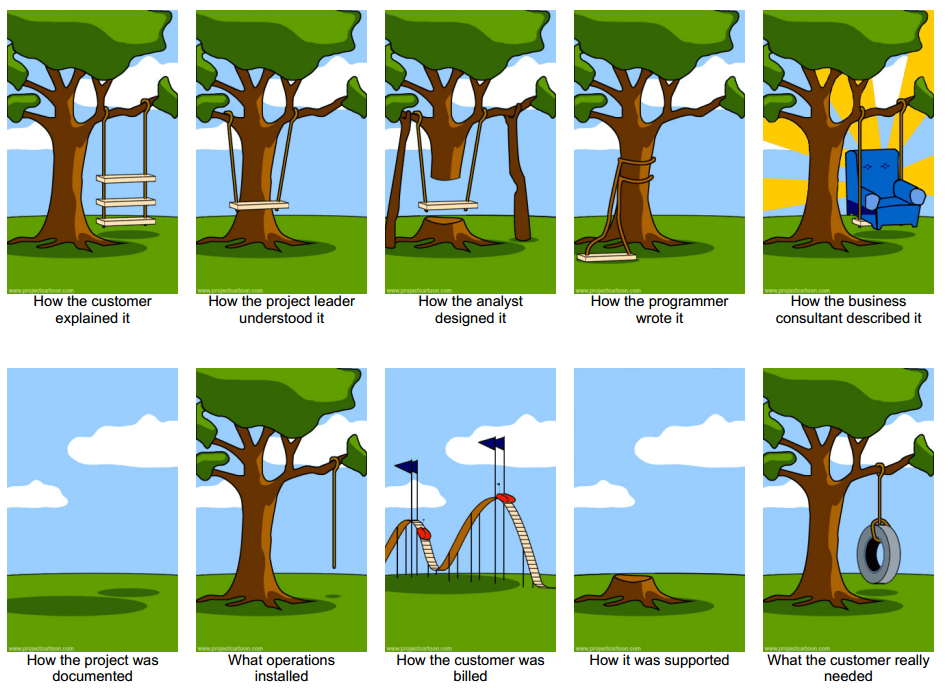
    When new clients meet me for the first time, they often talk about the idea that they have for a new web or mobile app, their goals, aspirations and product positioning. With product development, client expectations can be matched by a simple grid of what the product can and cannot do.

    Bespoke software development on the other hand is a bit more challenging. The client has a certain picture in his head about what he requires. Yet, requirements are never set in stone.

    As clients see their product being built, changes often creep in. In the same way, as users use the software, the client’s needs evolve.

    To avoid a mismatch of what the client wants and what the developer (or tech partner) develops, it is best to pin down exactly what is required. This is generally done in a business requirement specification (BRS).

    Once a blueprint of requirements is pinned down, a proper estimate of time and cost can be given. Tasks can also broken down into small chunks and delivered in an agile/incremental fashion.

    Understanding the requirements

    From a business perspective, it does make sense to understand what is required. However, it seldom offers insights into the end-user of the software.

    The users are often neglected for the greater vision and mission of the company, seen as a lagging factor that ‘users will get used to’. For a better view of the business and its requirements, it makes sense to include the following in the diagnostics phase:

    • Business requirements
      • Business goals for the solution
      • Timelines and output requirements
    • Expectations of the user
      • User personas – who will be using the website/software/app
      • Story flows – what would each of the users like to do and how will they achieve this
    • Technical requirements
      • API integrations
      • Third-party dependencies
      • Technology, architectural and code considerations

    The BRS – Needs mismatch

    Many clients would explain to me that they already have a BRS with a full needs analysis. It makes total sense that they would not want to pay again for another needs analysis. It would also be irresponsible of the new technology company to start solving client problems before they are engaged.

    Effectify focuses on simplifying what the clients think they need. For example, we know that a client has a 250 page BRS, a pitch deck and 10-year marketing plan for their innovative mobile app.

    With these details, we need to consider breaking down the project in smaller chunks – maybe there are online solutions, open-source code, APIs and third-party products that could decrease the time to market.

    Although the client would want to have a bespoke software solution, the need on a project could possibly be satisfied by other means that are more cost-effective, time saving and still deliver the same value.

    Conclusion

    It’s vital that the technology partner can do the job, but it is also important that you get along with them.

    The diagnostics phase is as much about requirements and understanding the business as getting to know your customer.

    Simply be effective.

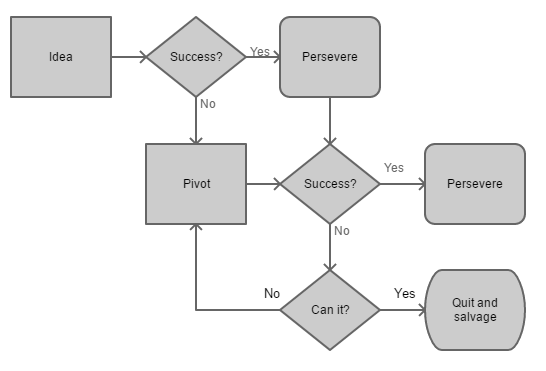
  • Should I pivot, persist or quit my startup?

    Should I pivot, persist or quit my startup?

    Choosing the right response to the problem

    Every business reaches the point where what they are doing is not working anymore. Small businesses and startups can reach this point much faster than bigger businesses with more diversified product offerings.

    When any business reaches the point where they realise that what they have is not working anymore, we need to make a decision: persist, pivot or quit?

    Before we get started, let us clarify what is meant with these bug terms:

    • Persist – when your idea/business/offering is sort of working: you have some clients, but it needs a bit refinement to make the product fit
    • Pivot – you have done the refinement, but you stil cannot get a good market fit. The feedback you’ve received back from your users/potential customers doesn’t fit into your initial hypothesis and problem to be solved. You would need to radically change your problem statement, target market etc. to reapply the solution (or part of it) to someone else
    • Quit – when you don’t see any way of salvaging the solution of pivoting. Don’t just quit!

    Explore/Exploit

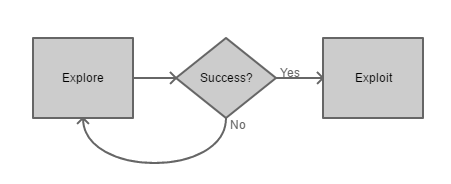
    In computer science, the explore/exploit algorithm teaches us the following: When something is worth it, keep on exploiting it until proven that it is not worth it anymore. When this point is reached, one should start exploring again.

    This exploring could mean three things.

    You could tweak your product offering to make it better. This is what Clayton Christensen refers to as sustaining innovation – the process of refining, tweaking and sustaining what you have. This is also the best way to optimise profit and add customer value to the existing product or service.

    If you decide to pivot, you realise that your hypothesis that you made initially was found to be untrue. In this case, you need to start with another assumption and hypothesis and retry the business in a new sphere. This could be a new target market, new (or sub) feature set, new approach or new angle.

    Lastly, you might decide to quit and salvage what you have. I refer to this as canning the project/business/startup. In this case, one might need to consider the following:

    • You have pivoted to a more successful business model, but none of these have worked. The startup is a bottomless pit eating all your money and it’s just not sustainable
    • The team dynamics is just not working – your startup team is causing division in the vision and process.
    • Other opportunities arise that are more lucrative and more sustainable

    Value innovation

    When deciding on preserving and/or pivoting, one needs to consider moving closer towards adding value to customers, while bringing down costs, effort and/or time required.

    As most startups are what Chan Kim and Renée Mauborgne calls a “blue ocean” (an uncontested market with a new innovative approach), it makes sense that these businesses should move toward adding maximum value to customers without the perception of paying more than they believe they should for the convenience

    Product Market Fit

    We know that the purpose of any startup is reaching product market fit. This means that customers want the product and are willing to pay for it. The reason that one would pivot or tweak, is to make it fit in with the feedback from the build-measure-learn cycle.

    If the offering does not fit the feedback, either tweaking or a pivot is required to make it fit. Choosing which of the two to implement depends on the degree that the initial hypothesis has been disproved.

    The pivot

    There could be a plethora of reasons that justify a pivot. In some scenarios, it might not mean that you need to rewrite the whole solution. Other pivoting options include:

    • Change the target market of your product
    • Change your business model
    • Revamp your engagement/revenue model
    • Take a subset of your existing product or service and spin it off into its own product or service

    Some of the reasons you need to consider when pivoting include:

    • Red oceans – too much competition
    • The company is not growing
    • a subset of your services/product offering is getting more traction than the actual service
    • You have changed: when the founder’s perception, knowledge (and revelation) of the market changes, it needs to reflect in the business/startup.

    Conclusion

    Choosing whether to pivot, explore or can a project or business is never easy. We are often emotionally involved and have difficulty making rational decisions.

    When considering whether to explore or pivot, one needs to consider all options including whereto, what will be at stake and how one will achieve the desired outcome.

    Don’t pivot because you can, but rather because you know the product market fit is just not there.

    Only quit when you have all the facts on the table and it’s absolutely not worth it anymore.

    Simply be effective.

    Sources consulted

  • How to validate your idea or feature before you code

    How to validate your idea or feature before you code

    Validate your learning

    I recently received an email from a potential customer who has an idea for a business and required funding. Though the money was not a large amount, I decided to take a leaner approach to the situation to try and understand how we can cut away wastage and provide a cheaper, more effective solution. I suggested that she starts small and with what she had, but the person wanted to go big or go home.

    Many people don’t believe in the power of learning, yet disruptive innovation is filled with learning being valued more than money:

    • Airbnb had to learn which part of their system is not complimenting the stay-at-home experience. This included discovering handing over cash, relooking the quality of the venue photos and targeting people outside of special events
    • Netflix learnt about customer behaviour and building up a relational database of which shows would be more appealing after watching certain shows

    Where did validated learning come from?

    Eric Ries first coined the term validated learning in 2011.

    The idea is that you test whether a feature, product or enhancement will add the value that you think it will.

    This can be achieved by firstly realising that we are making assumptions about how much value a feature will add to a system. Secondly, we need to be able to measure the effect that it has on the user – will this feature move the business forward? Are we able to validate this without writing the feature?

    The validation process

    Though this is not a one size fits all, the typical steps in validated learning can be seen as:

    1. Specify a goal – add details about what you want to learn
    2. Specify a metric that represents the goal – define how you will be able to achieve it. Include details such as software or analytics trackers to be used, methods etc.
    3. Act to achieve the goal – do what needs to get done to get the metrics in
    4. Analyze the metric – do the results align with the initial goal? Will this give you the result you need?
    5. Improve and try again – what did you learn? How are you using that?

    Examples of validated learning in software development

    Validated learning makes sense in small businesses and entrepreneurship, as one can test it directly with the customer.

    In most companies, the developer never sees anyone other than the immediate IT team, it can be challenging to change the mindset from a cost centre to a team of enablers.

    Yet, with a bit of creativity, the developers or business analysts are able to work through the validated learning process without interrupting business as usual.

    Some of these include gathering analytics through Azure Performance Monitoring, Google Analytics, HotJar or similar software. This can be combined with A/B testing and other methods to see if a button is clicked on or not.

    The case of the vital feature

    An accounting online software as a service (SAAS) solution received feedback from clients that they require a fairly large feature. They decided to add a menu item with the name of the feature. When the menu item as clicked, it navigated to a page saying “Coming soon”.

    Using Google Analytics, they realised that no one clicked on the page – it wasn’t something that added value to their clients.

    The large app requirement

    A client required a complicated mobile app. To simplify the requirements, we analysed the features that we believed to be most important. We built this into an MVP to pitch to clients.

    The client was able to demo the app with the basic features and receive feedback about what the users expected. The developers were also able to get feedback via analytics software to understand which features were clicked on most and which were not seen as important.

    Conclusion

    Validating your feature as valid, value-adding and worth the effort means that the developer codes knowing that his code will make a difference.

    Creating MVPs, prototypes, using analytics to track user activity can give us insight into what is actually important.

    Simply be effective.

  • Getting your software solution to market faster

    Getting your software solution to market faster

    When you have no time to spare

    Startups and small businesses often don’t have the budget, resources and expertise of large corporate businesses. This limitation can become the greatest strength by applying lean software development principles – eliminating waste and delivering only what the customer needs.

    Even though many developers love giving customers more than what they need in an attempt to under-promise and overdeliver. When developing for getting a product to market, all unnecessary elements need to be removed from the equation.

    This might include theming, customising, features, data filters, and other elements that might not be critically important for the customer right now.

    Needs analysis and focus

    A developer that works at a startup often needs to work long hours and deliver more than just code. To optimise the time spent as well as the effectiveness of the output, the developer need understands the customer needs to fulfil them appropriately.

    Needs can be analysed and discovered in many ways: Hotjar, Google Analytics and other tools offer us an insight into how customers interact with our solution.

    Startups and small businesses often have a low level of certainty concerning their customers’ needs. It would therefore make sense to take a leap of faith assumption and start testing their needs (and the assumptions that we make).

    Lean software development

    Lean software development is all about cutting waste and testing our assumptions about our clients, our product and the industry. The following is an outline of the process:

    1. Eliminate waste – determine what is actually important. Cut out unnecessary features or enhancements that are not critical.
    2. Amplify learning – Don’t spend days doing documentation and planning sessions that don’t deliver results. Have short iterations with regular customer feedback cycles included?
    3. Decide as late as possible – when dealing with uncertainty, it might benefit the client to create bite-sized solutions first – and therefore deferring larger decisions of the end product until more is learned of what is actually required.
    4. Deliver as fast as possible – time to market is crucial in getting user feedback. It, therefore, makes sense that any tools, plugins and other means must be used to move the project forward.
    5. Empower the team – allow software developers to make decisions about what their validated learning has proved to be correct.
    6. Build in integrity – The customer needs to be at the heart of what is done. The product must solve a specific problem. If the problem is solved successfully, it will build trust in the company and product. This, in turn, will build integrity so that the marketing, software and image all contribute to the same solution.
    7. Optimise the whole – Issues in software can damage the integrity of the software and brand. It is therefore vital that integrations with third parties, bugs and issues are prioritised on the urgent-important scale, where the most important and most urgent issues get the first attention.

    Think big, act small, fail fast; learn rapidly

    – Mary Poppendieck

    The minimum viable product (MVP)

    Many clients have the viewpoint that the only way to go to market is with a fully built product. This, however, can easily ruin a small company or startup financially.

    To the first paying client, one can create a minimum viable product to test their hypothesis and problem statement.

    For an MVP, the developer can use any means within reason to speed up output. The MVP could be something as small as a WordPress site with WooCommerce.

    One could easily test the use cases with WordPress – developing plugins and reporting for many cases. Once viability is determined and the system outgrows the MVP/prototype, a custom bespoke solution can be developed for more complex systems.

    Note that in some larger corporate solutions, the MVP might be a six-month project for a team. The focus should be on determining and developing what is actually important.

    For example, if a large life insurer would like to bring to market a tool to help financial advisors predict retirement income, a simple spreadsheet might be the first stop to see the reactions and needs of the financial advisors. When the solution is ready for coding, one could easily set up a simple front end with chart components and code back end that opens, writes, reads and calculates the values from an excel file before it’s translated into code.

    Tools to speed up delivery

    There is a plethora of software plugins, DLLs, open source projects and code snippets available that can assist in speeding up delivery.

    It’s worth doing a quick check for open source solutions available that could be used as a base for the MVP.

    Here are some ideas to get a project off the ground:

    • Base software – WordPress, DNN, open source CRMs and built in framework functionality (e.g. .NET Identity for authentication) can speed up a project to get it off the ground faster.
    • Front end plugins, libraries and frameworks – Jquery, Angular, Bootstrap, datatables.net and Telerik could also assist in meeting requirements for lean testing.
    • Dev-ops – Continuous integration tools (TeamCity, Jenkins), Continuous deployment (Octopus) and logging services (ElasitcSearch or appcenter.ms for mobile apps)
    • Cloud solutions such as Azure and AWS offers many services, functionality and APIs to speed up development

    Conclusion

    For many startups, the focus is on getting to market as soon as possible. They do not always have the time to wait six months for bespoke development.

    Rapid application development tools can assist developers in getting a customer’s product to market as soon as possible.

    Though one needs to weigh up the impact this might have in the long run, once the company’s cash flow is there, more enhancements can be added to the list.

    Simply be effective.

    Sources consulted